


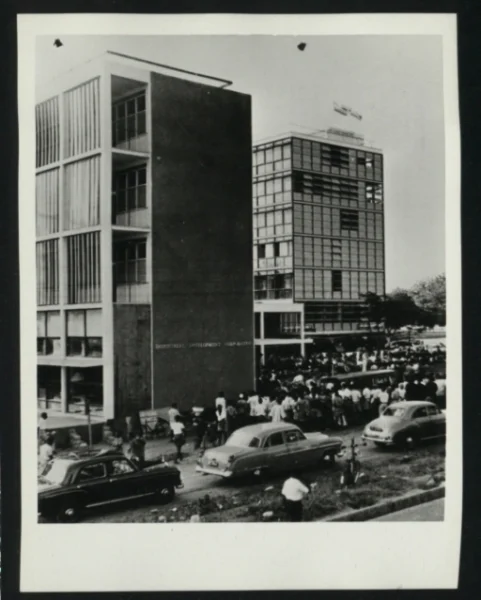
How old is Accra? It’s a question that, at first glance, seems straightforward, but peel back the layers of Ghana’s vibrant capital, and you’ll find not one, but many ages coexisting, whispering tales from different centuries.
THE EARLIEST RECORDED DATE OF EXISTENCE
On the surface, one might point to the imposing European forts that stud its coastline. For instance, during Danish dominance in the 17th century (around the 1660s), Christiansborg Castle (now Osu Castle) started off as a simple lodge. If you consider Accra’s age from the perspective of these colonial structures that shaped much of its early documented history, you’re looking at a city with roots firmly planted in the mid-1600s – roughly 350-360 years old. This is when it began to emerge as a significant trading post, a nexus of international commerce and, tragically, the transatlantic slave trade.
But to limit Accra’s age to its colonial foundations would be to ignore the deep, indigenous heartbeat that pulsed long before any European ship docked. Oral traditions and historical accounts speak of migrations and settlements preceding the arrival of the Europeans by centuries. Areas like Ga Mashie (Old Accra), with its distinct quarters like Jamestown and Usshertown, are the direct descendants of these older Ga settlements.

THE STRIVE FOR CHRONOLOGICAL ACCURACY
While precise founding dates for these indigenous communities are harder to pinpoint with exactitude, scholarly estimates and oral histories suggest that significant Ga settlements were established in the area now known as Accra by the 15th and 16th centuries, possibly even earlier. These were thriving fishing villages and farming communities, rich in culture and tradition.
So, is Accra 360 years old, or is it closer to 500 years, or perhaps even more?
The truth is, Accra is all these ages at once. The vibrant Homowo festival and the elaborate drumming that fills the streets are manifestations of the Ga people’s traditional spirit. It is the colonial influence of 17th and 18th century architecture and forts. The comparatively modern capital also shot to administrative importance in 1877 when it took Cape Coast’s place as the Gold Coast’s capital, and in 1957 when it became the capital of independent Ghana.
KEY TAKEAWAYS
The capital isn’t just a city; it’s a living archive, a palimpsest where layers of history are constantly being written over, yet never truly erased. It carries the wisdom of centuries in its bustling markets, the resilience of generations in its people, and the vibrant energy of a continuous, evolving story. Its age isn’t a single number, but a testament to its enduring spirit, a tapestry woven from threads both ancient and new.


