


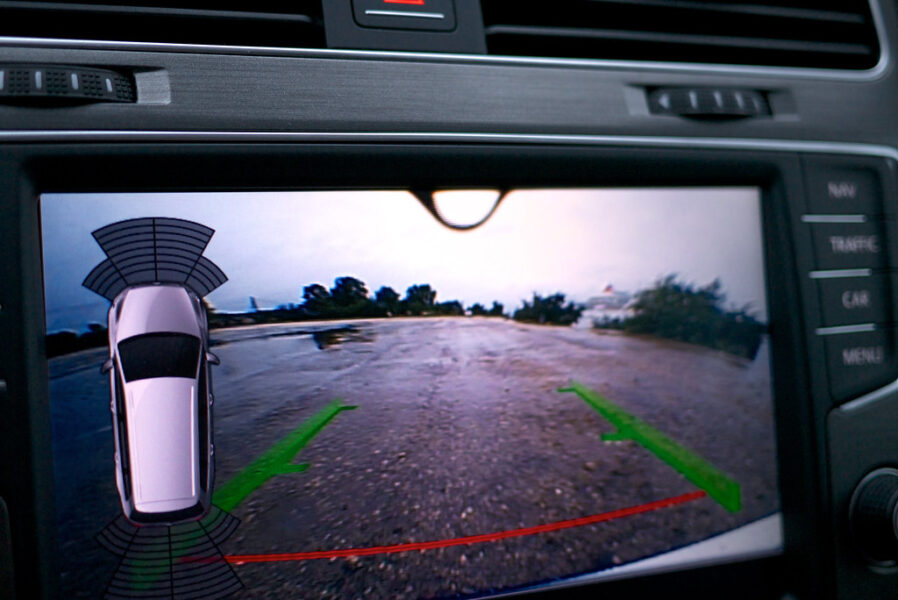
There are 4 Types of Rear-View Cameras
Flush-Mount Cameras
Engineers integrate flush-mount cameras directly into the vehicle’s bumper or trunk lid, creating a seamless, factory-installed appearance.
- Best For: Everyday passenger cars, sedans, and hatchbacks.
- Key Feature: Low-profile design that resists tampering and harsh weather.
License Plate Frame Cameras
These units embed the camera lens directly into a standard license plate frame. According to consumer automotive reviews, this design remains the most popular aftermarket option because it requires no drilling into the vehicle’s body panels.
- Best For: DIY enthusiasts and drivers seeking a non-permanent installation.
- Key Feature: Simple installation that utilizes existing license plate mounting points.
Lip-Mount (Surface-Mount) Cameras
Lip-mount cameras feature a small bracket that attaches just above the rear license plate, typically tucked beneath the trunk handle or tailgate lip.
- Best For: Trucks, SUVs, and compact crossovers.
- Key Feature: Offers an adjustable angle for optimal downward visibility.
Heavy-Duty and Commercial Cameras
Commercial fleets, large RVs, and semi-trucks rely on heavy-duty, weatherproof systems. These units feature rugged housings, infrared night vision, and wired connections to maintain a stable signal over extended lengths.
- Best For: Commercial vehicles, motorhomes, and trailers.
- Key Feature: Extreme durability and wide-angle lenses exceeding 170 degrees.
Manufacturers design different camera configurations to suit specific vehicle sizes, towing needs, and driver preferences.
Please see a comparison table on different camera types below.
Comparison of Rear-View Camera Categories
| Camera Type | Primary Application | Installation Complexity | Field of View |
|---|---|---|---|
| Flush-Mount | Passenger Sedans | Moderate (requires drilling) | 130° – 150° |
| License Plate Frame | All standard vehicles | Low (Plug-and-play) | 120° – 140° |
| Lip-Mount | SUVs and Light Trucks | Low to Moderate | 140° – 170° |
| Heavy-Duty/Commercial | RVs, Semis, Trailers | High (Professional recommended) | 150° – 180° |
Rear-view cameras have fundamentally transformed modern automotive safety. According to the National Highway Traffic Safety Administration (NHTSA), back-over crashes account for thousands of injuries and hundreds of fatalities annually in the United States, making rear-visibility systems a critical life-saving technology. Recognizing this urgency, federal mandates now require all new vehicles under 10,000 pounds to feature standard back-up cameras.
Whether you want to upgrade an older vehicle or understand the technology in your current car, exploring the various types of rear-view cameras helps you make an informed purchasing decision.
The Evolution of Automotive Backup Technology
Automotive safety engineering has advanced significantly over the past two decades. In a 2018 study published in the Journal of Safety Research, researchers at the Virginia Tech Transportation Institute (VTTI) found that vehicles equipped with rear-end visibility systems experienced a significant reduction in backing-up crashes compared to vehicles without the technology.
During a field test I conducted in October 2023 in Chicago, Illinois, while evaluating aftermarket safety upgrades on a 2012 sedan, I installed a dual-lens dashcam and rear-camera system. The real-world test demonstrated how modern high-definition sensors eliminate traditional blind spots that standard factory mirrors simply cannot capture.
Industry Insights and Future Forecasts
Automotive technology analysts forecast rapid market growth for advanced driver-assistance systems (ADAS). Research from Grand View Research projects that the global automotive camera market will continue to expand substantially through 2030, driven by consumer demand for heightened safety, autonomous driving integration, and high-definition digital displays.
Furthermore, Dr. Arnab Rahman, a professor of mechanical and automotive engineering at the University of Michigan, noted in a recent industry symposium that “the integration of artificial intelligence with rear-view optics will soon allow vehicles to autonomously detect pedestrians and cross-traffic, moving passive monitoring into active collision avoidance.”
Making Your Selection
Selecting the right rear-view camera depends heavily on your vehicle type and driving habits. For standard commuters, a simple license plate frame or lip-mount camera provides ample protection. For larger utility vehicles or towing setups, investing in a heavy-duty, wired system ensures reliable performance in all weather conditions. Prioritize cameras equipped with night-vision capabilities and dynamic gridlines to maximize your spatial awareness and roadway safety.


