


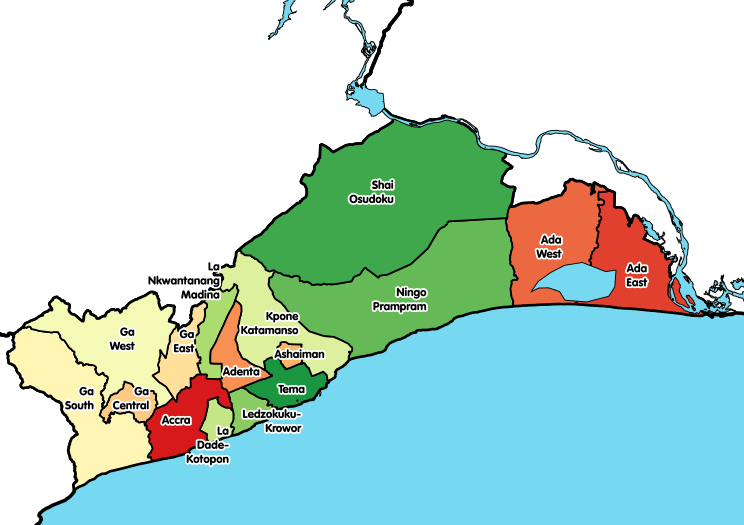
The Greater Accra Region (GAR) serves as the administrative, political, and economic epicenter of Ghana. As the country’s most densely populated region, its governance structure requires precise organization to manage rapid urbanization and deliver essential services effectively. For researchers, investors, and interested citizens, understanding the current administrative divisions is crucial.
So, precisely how many districts constitute the Greater Accra Region today?
The Definitive Answer is 29 Metropolitan, Municipal, and District Assemblies
The Greater Accra Region officially comprises 29 Metropolitan, Municipals, and Districts (MMDAs).
This current figure reflects the most recent administrative adjustments and decentralization efforts implemented by the Government of Ghana. The MMDAs form the fundamental units of local governance, driving development and coordinating public services across the region.
Understanding the Administrative Dynamics of Greater Accra
The number of districts in Ghana’s regions is not static; it changes periodically based on government policy aimed at enhancing governance efficiency and ensuring equitable distribution of resources.
Administrative boundaries frequently undergo review. When the population or geographical area of an existing district becomes too large for effective management, the government creates new administrative units through legislative instruments. This process, known as decentralization, ensures that local needs receive focused attention from dedicated administrative bodies.
For Greater Accra, this dynamism means that previous counts—such as the 16 MMDAs cited prior to 2018—no longer apply. The current total of 29 MMDAs empowers more localized decision-making, relieving pressure on the central authority.
The Three Categories of Greater Accra’s MMDAs
The 29 divisions in GAR fall into three distinct administrative categories, which reflect their population density, economic activity, and urban status:
1. Metropolitan Assemblies (MAs)
Metropolitans manage large, highly urbanized centers with significant populations. They spearhead complex regulatory and developmental initiatives. The Accra Metropolitan Assembly (AMA) stands as the primary example, overseeing the core parts of the capital city.
2. Municipalities (Mus)
They govern urban or peri-urban centers experiencing rapid growth. They manage infrastructure development, sanitation, and planning for medium-sized cities and towns. These unts often form crucial links between the densely populated metropolitan centers and the less urbanized district areas.
3. Districts (DAs)
They typically manage the less urbanized or rural areas within the region. They focus on local economic development, agricultural support, and grassroots service delivery, ensuring that rural communities also benefit from decentralized governance.
Why This Administrative Structure Matters
The division of GAR into 29 MMDAs directly impacts development planning and policy implementation. This decentralized structure offers several key organizational benefits:
- Improves Service Delivery: Smaller administrative units allow them to focus resources where residents need them most, improving sanitation, education, and health service accessibility.
- Enhances Accountability: Local governance structures hold elected officials directly accountable to the specific populations they serve, fostering greater transparency.
- Facilitates Urban Planning: With dedicated partners, planning authorities effectively tackle complex challenges unique to urban environments, such as traffic congestion and housing shortages.
In Sum
The Greater Accra Region currently utilizes a robust administrative apparatus consisting of 29 Metropolitan, Municipal, and District Assemblies. This configuration enables local authorities to drive development, manage rapid urbanization, and deploy government policies efficiently across Ghana’s leading commercial and governmental hub. Researchers and professionals rely on this current structure when analyzing regional development patterns and engaging with local governance initiatives.


